

How to Read a Schedule K-1 (Form 1065): A Simple Guide
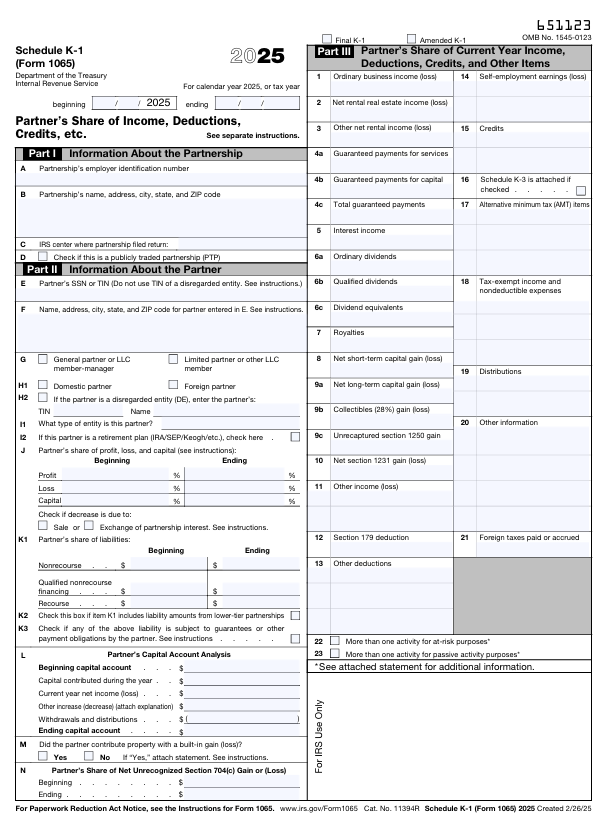
A Schedule K-1 (Form 1065) reports your share of a partnership’s income, deductions, and credits, and it’s split into three parts.
Part I identifies the partnership.
Part II identifies you and tracks your capital account.
Part III is where the real action is, listing your share of the money, box by box.
For most real estate investors, the line that matters most is Box 2, your net rental real estate income or loss, which is often a paper loss from depreciation even when the deal paid you cash.
Now, the first time I held one of these, I had no clue what I was looking at. I’m a dentist, so for years the only tax form I knew was my W-2. These days I read a stack of K-1s each year as an investor, and through Perdido Capital, I help issue them as a partner on the other side.
So I’ve seen this form from both chairs, and I promise it’s friendlier than it looks once you know where to look. Let me translate it for you.
What Is a Schedule K-1?
A Schedule K-1 is the tax document that pass-through entities use to report your slice of the action. Partnerships file Form 1065, S corporations file Form 1120-S, and trusts and estates file Form 1041. None of them pay tax at the entity level. They pass the income, losses, deductions, and credits through to the owners, and the K-1 tells you and the IRS what your share was.
So instead of a W-2 from an employer or a 1099 from a client, you get a K-1 when you own a piece of a pass-through entity. Whatever lands on it flows onto your personal return, usually on Schedule E of your Form 1040.
When Will You Get Your K-1?
Partnerships and S corporations generally have to file by March 15, which shifts to the next business day when that date lands on a weekend, so you’ll usually see your K-1 around then. Many real estate deals file an extension, which pushes the deadline to September, so don’t panic if yours runs late.
One rule worth following: don’t file your personal return until your K-1s are in hand. File early, forget one, and you could be amending your return later. If a K-1 is running late, your CPA can estimate it and file an extension on your side.
Don’t Miss Any Updates. Each week I’ll send you advice on how to reach financial independence with passive income from real estate.
Sign up for my newsletterThe K-1 Has Three Parts
Once you see the structure, the whole form gets a lot less intimidating.
Part I: About the Partnership
This is the easy part. It lists the partnership’s name, address, and EIN, and confirms it filed Form 1065. Glance at it and move on.
Part II: About You, the Partner
This is your section. It shows your name and tax ID, your ownership percentage, whether you’re a general partner or a limited partner, and your capital account activity for the year.
Two things here matter more than people realize. First, look at item K, your share of the partnership’s liabilities. That debt can add to your tax basis, which is part of why investors in leveraged real estate often have room to absorb big losses.
Second, don’t be alarmed if your capital account goes negative. That’s normal when your share of depreciation and losses runs larger than what you put in.
Part III: Your Share of the Money
This is where you’ll spend your time, and where the value lives. It’s a series of numbered boxes, each one a different type of income, loss, deduction, or credit. You don’t need all twenty memorized. You need the handful that actually show up for a real estate investor.
The Boxes That Matter Most
Here’s the short list worth knowing, with the others left to your CPA.
| Box | What It Reports | Why It Matters to You |
|---|---|---|
| Box 1 | Ordinary business income or loss | Often near zero in a real estate syndication |
| Box 2 | Net rental real estate income or loss | The big one, usually where your depreciation paper loss shows up |
| Box 5 | Interest income | From the deal’s cash reserves sitting in the bank |
| Boxes 8 and 9 | Short and long term capital gains | Show up mainly when the property sells |
| Box 13 | Other deductions | Your share of certain deductions (credits live in Box 15, not here) |
| Box 19 | Distributions | The actual cash you received, which often differs from your taxable number |
| Box 20 | Other information | Includes your Section 199A figure for the 20% pass through deduction |
A couple of notes on the rest. Box 11 is other income, Box 16 covers international transactions and now ties to Schedules K-2 and K-3 if the deal has any foreign activity, and Box 17 holds alternative minimum tax items.
If those show up, that’s a flag to hand the whole thing to a CPA who knows pass through entities, not to panic.
A Real Example: How a Loss Saves You Money
Let me show you why Box 2 is usually your friend. Say you invest $100,000 in a real estate syndication and your K-1 shows a net rental loss of $105,920 in Box 2. That looks alarming until you realize it’s mostly depreciation, a noncash expense. No money actually left your pocket.
In fact, you may have received cash distributions during the year, which you’d see in Box 19, while the IRS still treats your position as a loss. So you collected cash and paid no tax on it, at least for now. That loss then offsets other passive income, and if you don’t have any this year, it carries forward to future years with no expiration.
This got more powerful recently. The One Big Beautiful Bill Act, signed July 4, 2025, permanently restored 100% bonus depreciation for qualifying property placed in service after January 19, 2025. Paired with a cost segregation study, that’s exactly what front loads a big paper loss into Box 2 in year one.
So those numbers are bigger now than they’ve been in years.
Can a K-1 Loss Reduce Your W-2 Income?
This is the question everyone asks when they see that loss, so here’s the honest version. For most passive investors, no.
A passive loss can’t touch your wages unless you or your spouse qualifies as a real estate professional, or you use a short term rental where you materially participate.
I walk through every exception in can K-1 losses offset your W-2 income, and the full mechanics in how a K-1 loss affects your taxes.
What to Do With Your K-1
Keep it simple. Look over your capital account in Part II and the boxes in Part III so nothing surprises you, then hand the form to your CPA along with the rest of your tax documents. Wait until all your K-1s arrive before you file.
And each year, keep a running record of every K-1, what you invested, what you were paid, and how your losses carry forward, so you and your advisor can plan instead of scramble.
The Bottom Line
A K-1 looks like alphabet soup the first time you see it, but it really comes down to three parts and one key line. Part I is the partnership, Part II is you, and Part III is your share of the money, where Box 2 usually holds a depreciation driven loss that’s working in your favor.
Read it that way, and the form stops being scary and starts being a roadmap to keeping more of what your investments earn. You don’t have to master every box. You just need to know what you’re looking at and hand it to a good CPA.
If you want to see the kinds of deals that generate these K-1s and learn this alongside other high earning professionals, come join us in the Passive Investors Circle.
This is not financial or tax advice. Always consult your own financial advisor or CPA before making any investment decisions.
Join the Passive Investors Circle